My Favorite Nurse Call Me Mama Design
A Designer’s First Look: Warm, Clear, and Purpose-Built
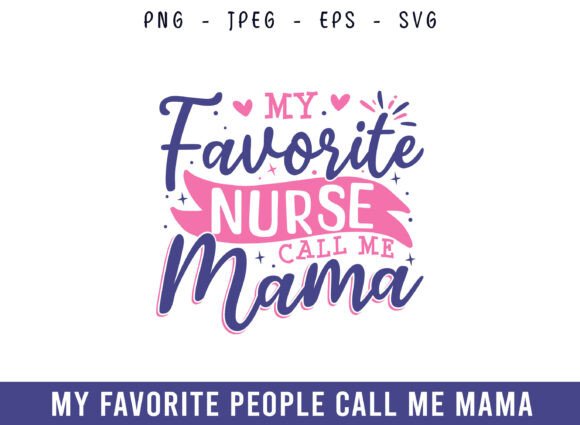
When I opened My Favorite Nurse Call Me Mama Design, I didn’t just see a Mothers Day SVG—I saw a quiet moment of recognition. The layout balances soft curves with clean lettering, and the “Nurse” detail isn’t tucked away or stylized beyond readability—it’s integrated with gentle confidence. As an embroidery designer who’s stitched hundreds of mom-themed pieces for boutique clients and Etsy sellers, I immediately sensed this wasn’t made for generic mass production. It’s designed to land like a hug: warm, intentional, and quietly proud.
How It Stitches in Real Life—Not Just on Screen
Last week, I prepped a custom embroidered tote bag for a labor & delivery nurse’s retirement gift. I chose My Favorite Nurse Call Me Mama Design as the centerpiece—not because it was trendy, but because its proportions held up at 4.2 inches wide, its line weight stayed legible after digitizing, and the spacing between “Call Me Mama” gave breathing room for satin-stitched letters without crowding. On medium-weight canvas, with tear-away + cut-away stabilizer, the fill stitches laid flat, the curves stayed smooth, and the tiny heart (yes, there’s one—subtle, not cutesy) stitched cleanly without thread nesting.
I also tested it on a lightweight cotton baby onesie. Here’s where attention to detail matters: the design’s vector-based construction meant scaling down to 3 inches preserved crisp edges—no pixelation, no jagged corners. That’s critical when embroidering baby embroidery or delicate holiday embroidery. It translated well into an applique design too, especially for nursery decor or embroidered patches meant for scrubs or lab coats.
Where It Shines—and Where You’ll Want to Pause
My Favorite Nurse Call Me Mama Design works beautifully on sweatshirt embroidery, tote bag design, aprons, pillow covers, and tea towels. Its balanced negative space keeps stitch density manageable, so it won’t overwhelm thin fabric or cause puckering on stretchy fabric. I’ve used it successfully on dark fabric with light thread and white t-shirts with navy or burgundy—thanks to its strong silhouette and generous letter height.
But here’s what I’d flag for fellow designers and craft business owners: avoid using it full-size on curved surfaces like caps unless you adjust the layout first. The baseline isn’t built for extreme distortion, and dense satin-stitched areas near the word “Mama” can shift slightly on unstructured caps without proper hooping and stabilizer. Also, while the design is made with 100 vector shapes (great for resizing), some interior details—like the small cross icon sometimes included in nurse-themed variants—may need manual cleanup if digitized below 2.5 inches. Always test the embroidery file on scrap fabric first, especially for commercial embroidery projects where consistency matters.
What This Design Says About Your Finished Product
Customers don’t buy embroidery files—they buy meaning, care, and clarity. When someone sees My Favorite Nurse Call Me Mama Design on a handmade product, they feel seen. Not “cute,” not “generic mom”—but *specific*. That specificity builds trust. A nurse receiving this on a personalized gift knows the creator understood her dual role: caregiver and mother. That emotional resonance lifts perceived value, supports brand consistency for small shop products, and boosts buyer engagement—especially for Etsy sellers listing holiday embroidery or graduation gifts.
It also reinforces professionalism. Unlike overly ornate graphics that blur when stitched, this design respects the limits of machine embroidery design. No tiny serifs. No overlapping fine lines. No high-contrast gradients that vanish in thread. That restraint makes your finished product look intentionally crafted—not rushed or auto-digitized.
Practical Notes Every Embroidery Designer Should Keep Handy
- Test before committing: Run a sample on the exact fabric + stabilizer combo you’ll use—even if it’s the same design on a different garment type.
- Check thread color contrast early: What reads clearly on screen may disappear on dark fabric. Try black-and-white mockups before finalizing thread colors.
- Review stitch density visually: Zoom in on your embroidery software. Look for tight clusters near curves or transitions—those often need slight pull compensation or reduced density.
- Confirm hoop size compatibility: While the SVG is resizable, your machine’s maximum hoop area sets hard limits. Don’t assume 6x10 will fit everything.
- Inspect small details at actual stitch size: That little stethoscope or caduceus (if included in your version) must be large enough to read after stitching—not just on your monitor.
- Verify licensing for commercial use: Since this falls under Graphics and Crafts, confirm whether the digital embroidery file permits resale of finished embroidered items or only personal use.
- Compare light vs. dark backgrounds: Use printable mockups to preview how My Favorite Nurse Call Me Mama Design reads on mugs, tees, and tote bags before listing on Etsy or at a craft fair.
Final Thought: A Design That Serves the Story
This isn’t just another Mom SVG. My Favorite Nurse Call Me Mama Design succeeds because it serves a real story—not just a holiday or title. It fits naturally into custom apparel, baby embroidery, and heartfelt holiday embroidery without shouting. For small business owners building a catalog of meaningful handmade products, it’s a reliable, versatile asset. For crafters choosing designs that reflect care—not just craft—it’s a quiet standout. And for nurses who wear their hearts on their sleeves (and scrubs, and tote bags), it’s exactly the kind of thoughtful, well-executed detail that makes a finished product feel truly personal.